Affordable early cancer diagnostics: the global access gap
By OncoFirm Diagnostics · Last updated October 2026
Affordable early cancer diagnostics are needed because cancer is common everywhere, with GLOBOCAN estimates for 2022 of 20 million new cases and 9.7 million deaths worldwide (Bray et al., 2024), while the pathology, imaging and laboratory capacity needed to diagnose it is unevenly distributed. A low price per test does not close that gap on its own: a test is affordable only if a health system can buy it, run it reliably and act on the result.
What follows covers what the access gap consists of, what affordability has to include, and what evidence should exist before any low-cost test is deployed. It describes a research problem, not a product.
The access gap is largely a diagnosis gap
The WHO Guide to cancer early diagnosis (2017) distinguishes early diagnosis, meaning prompt recognition of symptomatic cancer, from screening of people without symptoms. It describes three steps at which delay occurs: awareness and access to care; clinical evaluation, diagnosis and staging; and access to treatment.
A diagnostic test acts on the middle step only. If people present late, or if treatment is unavailable or unaffordable after diagnosis, a faster test changes little. That is why the argument for early detection is an argument about whole pathways.
What affordable has to mean in practice
The cost that matters is the cost of a correct, recorded result that leads to action, not the price per cartridge.
| Dimension | What to count |
|---|---|
| Cost per reportable result | Consumables, reader and maintenance, invalid and repeated runs, controls, and confirmatory testing of positives |
| Infrastructure | Power, temperature and humidity limits, storage without a cold chain, connectivity |
| Training | Time to competence for non-laboratory staff, error rates, retraining and staff turnover |
| Supply chain | Shelf life, lot consistency, import and registration requirements, continuity of supply |
| Quality assurance | Internal controls, external quality assessment and a route for reporting failures |
What point-of-care formats can and cannot contribute
Lateral flow assays are attractive in this setting because they are inexpensive to manufacture, need little equipment and can often be stored without refrigeration (Posthuma-Trumpie et al., 2009). The WHO Model List of Essential In Vitro Diagnostics organizes recommended tests by level of the health system, including facilities without a laboratory.
Experience with infectious-disease tests is a caution as much as an encouragement. Drain et al. (2014) make the case that a point-of-care test changes outcomes only if it is built into a clinical pathway with a decision attached to each result. For cancer, a positive biomarker result still has to be followed by imaging, biopsy and pathology, so a rapid test can shorten one step but cannot replace the rest. Formats are compared in our map of rapid cancer diagnostic technologies and in point-of-care testing in oncology.
Evidence needed before a low-cost test is deployed
- Analytical performance under field conditions: heat, humidity, capillary versus venous blood, and operators with brief training.
- Clinical validation in the local population, including people with infections, inflammatory conditions and benign disease that can raise the same markers.
- A defined intended use: triage of symptomatic patients and screening of people without symptoms need different evidence.
- Effect on the pathway: time to diagnosis, stage at diagnosis, completion of follow-up, and harms from false positives and false negatives.
- Economic evaluation: cost per correct diagnosis compared with the existing pathway.
- Regulatory authorization in each country of use, and a quality system for manufacture.
Screening claims carry the heaviest burden of proof (Crosby et al., 2022), for reasons set out in the future of cancer screening.
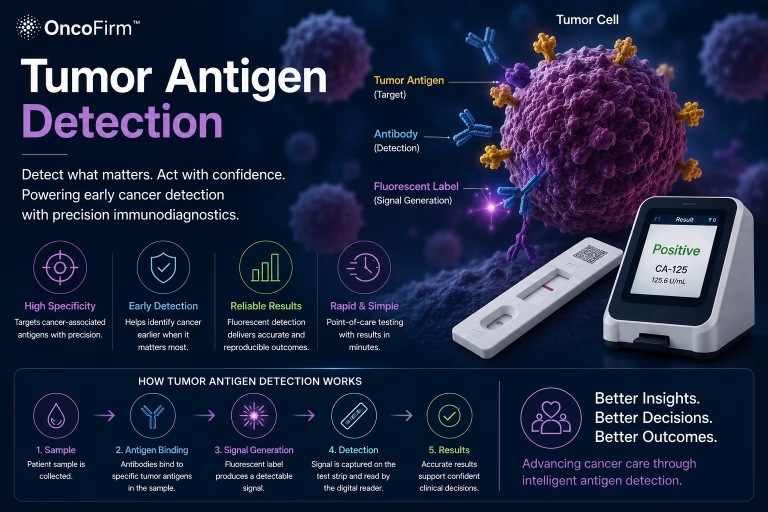
OncoFirm™ is developing a research-stage fluorescent lateral flow immunoassay platform and a prototype portable reader. Their performance has not been established and no product is available. Cost, stability and usability in low-resource settings are open design questions, not demonstrated properties.
Working with ministries of health, NGOs and global-health researchers
These questions can only be answered where a test would be used. OncoFirm is interested in joint grant applications and pilot studies with ministries of health, non-governmental organizations and global-health research groups that can define local needs, enroll appropriate study populations under ethical approval, and assess usability and cost in working clinics.
Such studies would be research: designed with local investigators, reviewed by local ethics committees, and not a route to distributing an unvalidated test. Current questions are listed under research and development priorities. To propose a joint application, use the collaboration opportunities page.
Frequently asked questions
Why is cancer often diagnosed late in low-resource settings?
The WHO guide describes delays at three steps: awareness and access to care, clinical evaluation and diagnosis, and access to treatment. Limited pathology and imaging capacity affects the second, but all three matter.
Would an inexpensive rapid test solve the problem?
Not alone. A test helps only if it is accurate in the setting where it is used, if positive results lead to confirmatory diagnosis, and if treatment is then available.
Does OncoFirm have a low-cost cancer test available for health programs?
No. OncoFirm’s platform is in research and development. Its performance has not been established and no product is available for sale or distribution.
Related research and resources
- Why early detection matters — the evidence behind earlier diagnosis and its limits.
- Grant programs — the funding mechanisms being pursued with partners.
- Discuss a grant opportunity — propose a pilot study.
References and further reading
- Bray F, Laversanne M, Sung H, et al. Global cancer statistics 2022: GLOBOCAN estimates of incidence and mortality worldwide for 36 cancers in 185 countries. CA Cancer J Clin. 2024;74(3):229–263.
- World Health Organization. Guide to cancer early diagnosis. Geneva: WHO; 2017.
- World Health Organization. WHO Model List of Essential In Vitro Diagnostics.
- Drain PK, Hyle EP, Noubary F, et al. Diagnostic point-of-care tests in resource-limited settings. Lancet Infect Dis. 2014;14(3):239–249.
- Posthuma-Trumpie GA, Korf J, van Amerongen A. Lateral flow (immuno)assay: its strengths, weaknesses, opportunities and threats. A literature survey. Anal Bioanal Chem. 2009;393(2):569–582.
- Crosby D, Bhatia S, Brindle KM, et al. Early detection of cancer. Science. 2022;375(6586):eaay9040.
Research and regulatory status
OncoFirm™ technologies described on this site are in research and development. Their performance characteristics have not been established, and no OncoFirm product has been cleared, approved or authorized by the U.S. Food and Drug Administration. Nothing here is medical advice. Reference to a federal agency or funding program does not imply endorsement, funding, sponsorship or affiliation.