Point-of-care oncology testing: what must be shown first
By OncoFirm Diagnostics · Last updated October 2026
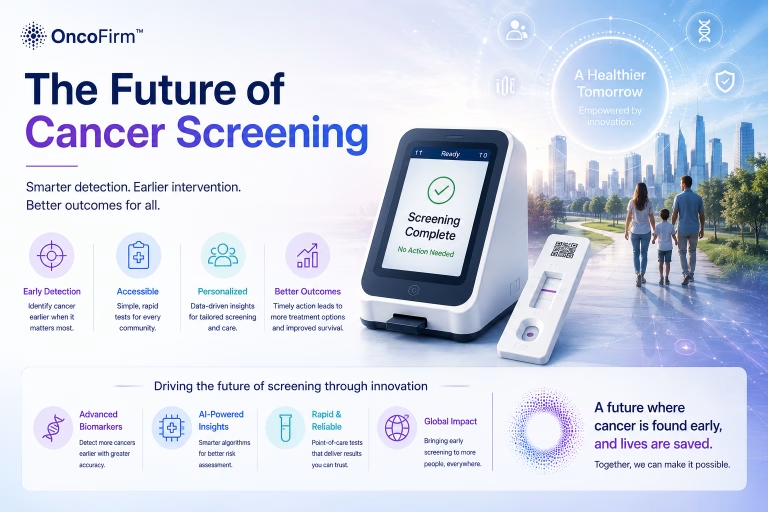
Point-of-care oncology testing means measuring a cancer-related analyte at or near the place where the patient is seen, with the result available in time to inform a decision at the same visit. For blood biomarkers it is still largely a research goal: most such measurements are made in central laboratories.
Speed and portability are the easiest properties to describe and the least of what has to be demonstrated. A near-patient test is useful only if it is accurate in the hands of its intended users, agrees with the laboratory method, and leads to an action the health system can deliver (Drain et al., 2014).
What point-of-care means in an oncology pathway
Cancer is not diagnosed by one test. The pathway runs from suspicion through imaging and tissue sampling to staging and treatment (World Health Organization, 2017). A near-patient test can only change the early steps: who is referred, how urgently, and who needs imaging. In people with known disease it could also track a marker between visits.
The closest precedents sit in screening. Immunochemical tests for hemoglobin in stool, some of them strip tests, are used in colorectal screening, and near-patient HPV tests are used in some cervical screening programs. Both lead to a further clinical step, and neither is a diagnosis.
Enabling technologies
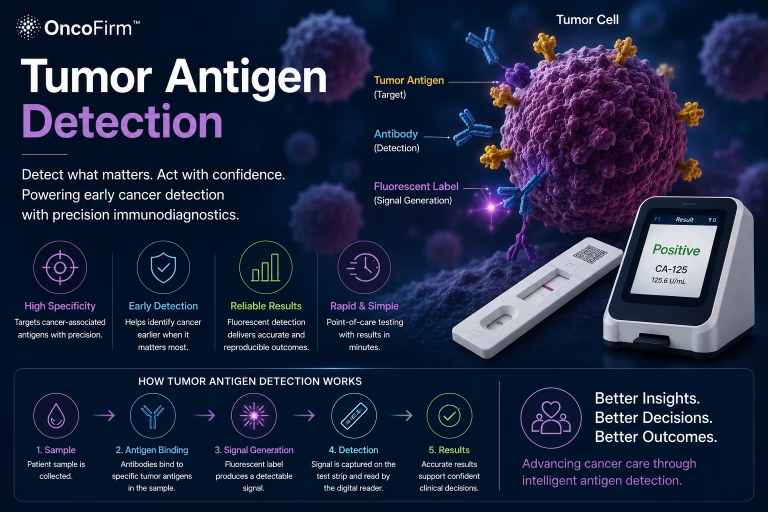
- Lateral flow immunoassays, the most widely used near-patient immunoassay format, whose known weaknesses of limited sensitivity and lot variation travel with them (Posthuma-Trumpie et al., 2009); see how lateral flow assays work.
- Fluorescent labels and compact readers, which make a strip result numerical, as compared in fluorescent vs gold nanoparticle lateral flow assays.
- Microfluidic cartridges that automate sample preparation and metering.
- Electrochemical and optical biosensors, largely at the research stage for oncology.
- Software for signal interpretation, including machine learning, which carries its own good-practice expectations for development and monitoring (U.S. Food and Drug Administration, Health Canada and MHRA, 2021).
Four kinds of evidence needed before clinical use
Each is a separate body of evidence, and a gap in any one of them is enough to stop a test.
Analytical validation
Precision, detection and quantitation limits, linearity, interference, high-dose hook effect, reagent stability and agreement with an accepted laboratory method, all in the intended specimen type, such as fingerstick whole blood.
Clinical validation
Sensitivity, specificity and predictive values in the intended-use population, with prespecified cutoffs, operators blinded to the diagnosis and an independent validation set. Comparison with healthy volunteers alone is not enough.
Usability and human factors
Evidence that the intended operators, usually not laboratory staff, obtain the same results as experts under real conditions of timing, sample volume, temperature, lighting and interruption.
Connectivity
Results that reach the patient record with operator, lot and quality control data attached, typically through a laboratory information system. A result that is not recorded cannot be audited or trended.
Regulation and quality oversight
In the United States, any site testing patient specimens needs a CLIA certificate, and a site holding only a Certificate of Waiver may run only tests that FDA has categorized as waived. That categorization depends on showing that the test is simple to use and that untrained operators obtain accurate results. Marketing authorization is a separate requirement.
Authorization does not end the work. Good practice for near-patient testing programs still calls for operator training, routine quality control and external quality assessment, usually under laboratory supervision.
Realistic settings for use
Three settings are plausible if the evidence is produced. In primary care, a test could help decide which symptomatic patients need urgent referral. In oncology clinics, a marker result on the day of the visit could inform a consultation, provided it agrees with the laboratory method.
The third is health systems with limited laboratory access. The WHO Model List of Essential In Vitro Diagnostics groups tests by health system tier, including facilities without laboratories. A test helps there only when diagnosis and treatment services exist to act on it (Drain et al., 2014). Unsupervised self-testing for cancer and stand-alone diagnosis are not realistic uses on present evidence.
Validation work open to research partners
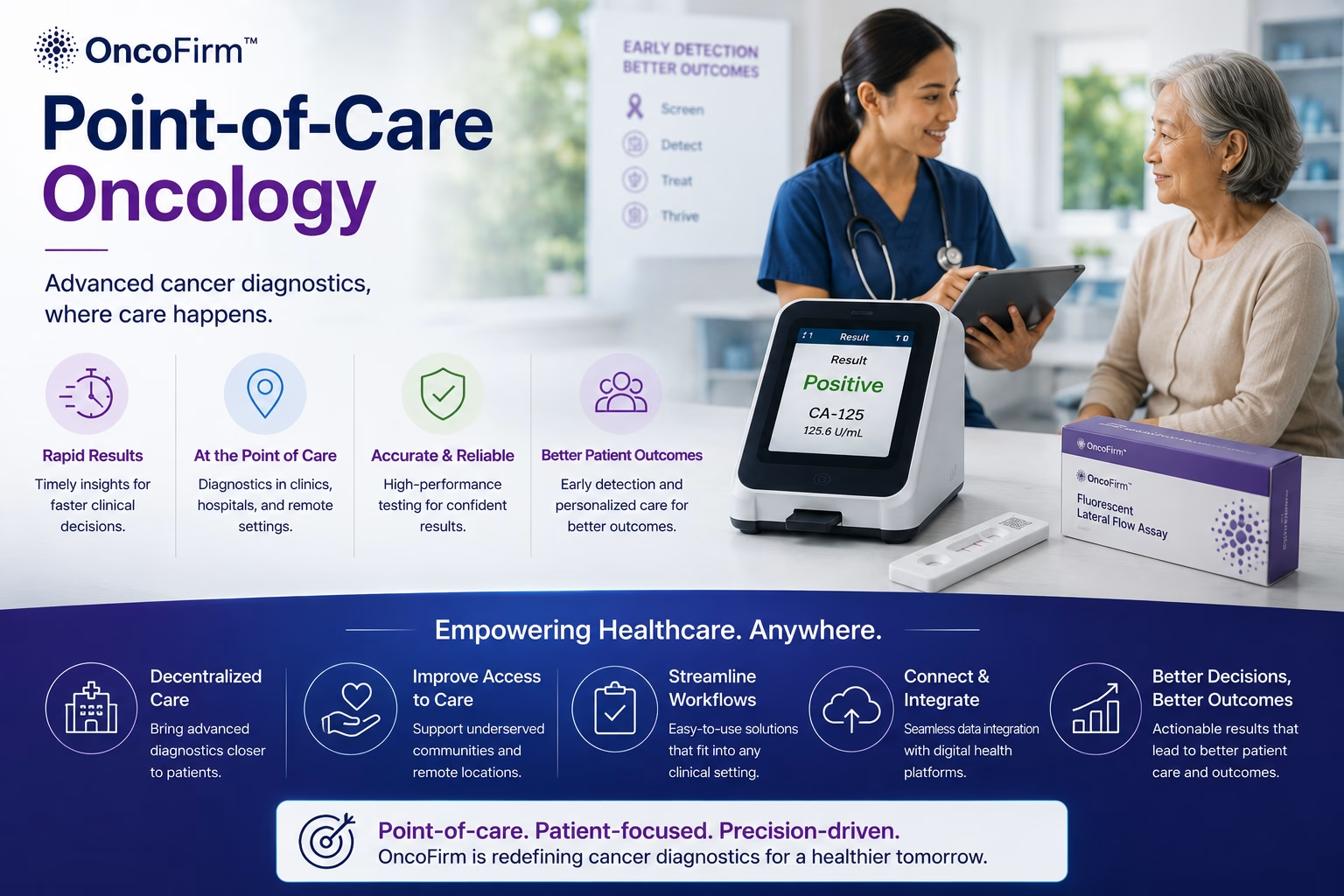
OncoFirm™ is developing a fluorescent lateral flow immunoassay platform, a prototype portable digital fluorescence reader and AI-assisted signal interpretation software. All are at the research stage, and none of the four kinds of evidence above has been established.
Producing it is collaborative by nature: clinical sites for method comparison and usability studies, human factors engineers, and health informatics groups for connectivity. The clinical collaborations page describes how sites can take part, or you can discuss a grant opportunity directly.
Frequently asked questions
What is point-of-care testing in oncology?
Testing for a cancer-related analyte at or near the site of patient care, with a result available during the visit. For blood biomarkers it is mostly at the research stage.
Is there a point-of-care test that can diagnose cancer?
No. Diagnosis of a solid tumor requires imaging and tissue pathology. A near-patient test can at most inform who needs that workup or track a known marker.
How is a point-of-care test compared with a laboratory test?
By a method comparison study: the same specimens are measured on both, and the differences are analyzed across the measuring range, with particular attention to values near clinical cutoffs.
What is a CLIA waiver?
A waived test is one that FDA has categorized as simple enough, and with low enough risk of an incorrect result, to be run at a site that holds only a CLIA Certificate of Waiver. Every site testing patient specimens still needs a CLIA certificate of some kind.
Related research and resources
- How lateral flow assays work — the strip format behind most near-patient immunoassays
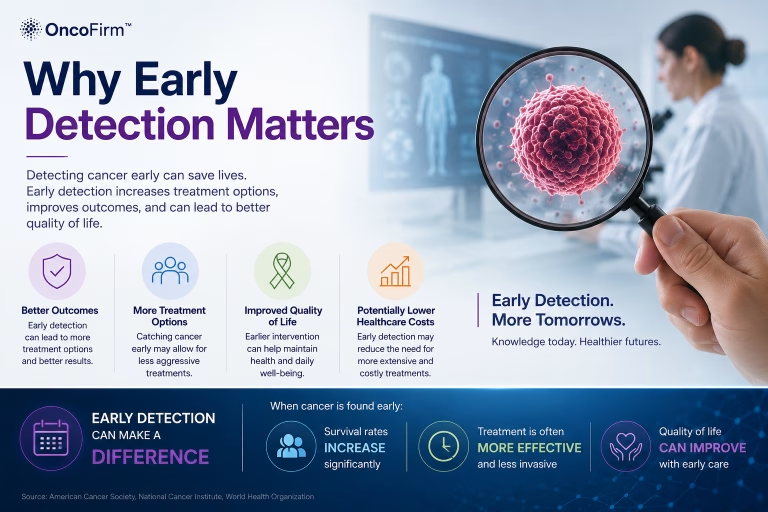
- Why early cancer detection matters — why a faster test is not automatically a beneficial one
- The global need for affordable cancer diagnostics — the access problem near-patient testing is meant to address
- Clinical development pathway — the stages an investigational diagnostic passes through
References and further reading
- Drain PK, Hyle EP, Noubary F, et al. Diagnostic point-of-care tests in resource-limited settings. Lancet Infect Dis. 2014;14(3):239–249.
- World Health Organization. WHO Model List of Essential In Vitro Diagnostics.
- World Health Organization. Guide to cancer early diagnosis. Geneva: WHO; 2017.
- Posthuma-Trumpie GA, Korf J, van Amerongen A. Lateral flow (immuno)assay: its strengths, weaknesses, opportunities and threats. A literature survey. Anal Bioanal Chem. 2009;393(2):569–582.
- U.S. Food and Drug Administration, Health Canada, MHRA. Good Machine Learning Practice for Medical Device Development: Guiding Principles. 2021.
Research and regulatory status
OncoFirm™ technologies described on this site are in research and development. Their performance characteristics have not been established, and no OncoFirm product has been cleared, approved or authorized by the U.S. Food and Drug Administration. Nothing here is medical advice. Reference to a federal agency or funding program does not imply endorsement, funding, sponsorship or affiliation.