The future of cancer screening: what research still has to prove
By OncoFirm Diagnostics · Last updated October 2026
The future of cancer screening is likely to be more risk-stratified, to add blood-based biomarker tests alongside imaging and endoscopy, and to use software to help interpret results. At the time of writing, it is not yet known whether these newer approaches reduce deaths from cancer, or what they cost in false positives, overdiagnosis and follow-up procedures (Crosby et al., 2022; Minasian et al., 2023).
Written for investigators planning studies, this article separates what has been demonstrated from what has been assumed and lists the evidence questions that future studies and grant applications need to address.
Five research directions and what each still has to show
| Direction | What it proposes | What remains unproven |
|---|---|---|
| Risk-stratified screening | Set starting age, interval or test type by estimated risk | Calibration of risk models; safety of less intensive schedules |
| Multi-cancer detection blood tests | Look for a shared blood signal across many cancer types | Effect on cancer mortality; burden of the workup after a positive result |
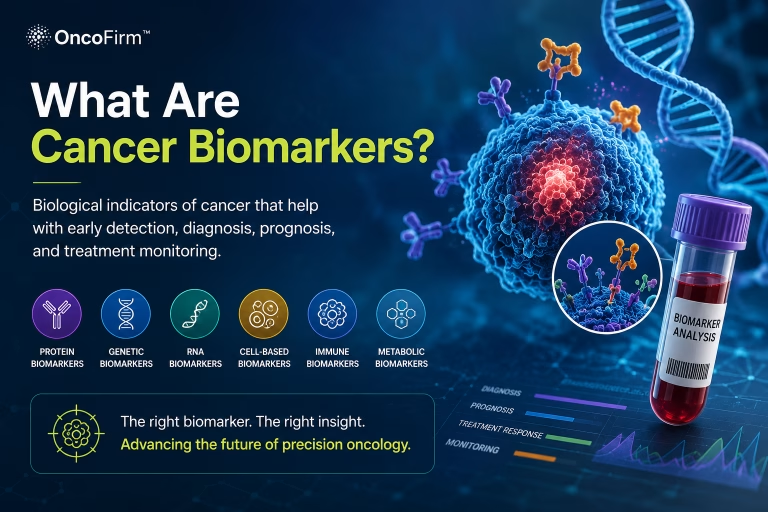
| Protein biomarker panels | Combine several circulating proteins where no single marker is adequate | Performance in early-stage disease and in people with benign conditions |
| AI-assisted interpretation | Use trained models to read images or combine assay signals | Performance at new sites and in new populations |
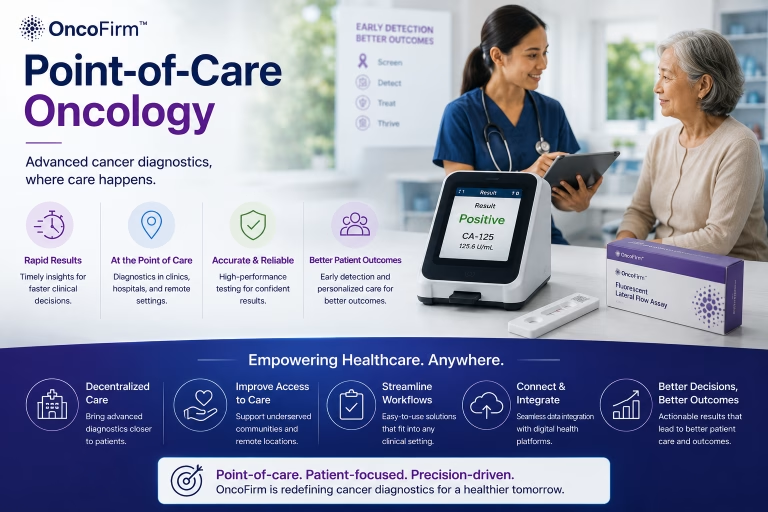
| Point-of-care formats | Move selected measurements closer to the patient | Performance outside the laboratory; linkage to follow-up care |
Risk-stratified screening: matching intensity to risk
Established programs for breast, cervical, colorectal and, in high-risk groups, lung cancer mostly decide eligibility by age, sex and a few exposure criteria. Risk-stratified screening would refine this with family history, genetic risk scores and prior results, so that screening intensity follows risk.
The research burden is heavier than it looks: a risk model has to be calibrated in the population where it will be used, and the less intensive schedule has to be shown to be safe.
Multi-cancer detection: what the studies so far show
Early validation of a methylation-based test compared people already known to have cancer with people without it (Klein et al., 2021). That case-control design is an efficient way to show that a signal exists, but it tends to overstate performance relative to testing people without symptoms, in whom cancers are rarer and earlier.
Prospective studies have also returned results to participants and followed the diagnostic workup that resulted (Lennon et al., 2020; Schrag et al., 2023). They show that such testing is feasible and describe what happens after a positive result. They were not designed to show a reduction in cancer deaths. An evaluation framework is summarized under AI multi-biomarker blood tests.
The evidence questions future studies need to answer
Minasian et al. (2023) describe why trials of multi-cancer tests are hard to design: many cancer types with different natural histories, long follow-up for mortality endpoints, and the need to keep standard screening in place. The same questions apply to any new screening approach.
- Intended-use performance. Sensitivity by stage and cancer type, and specificity, in the population that would be tested.
- Endpoint. Whether a fall in late-stage diagnoses is an acceptable surrogate for cancer mortality.
- Harms. False positives, overdiagnosis, incidental findings and the procedures that follow.
- Diagnostic resolution. What workup follows a positive result, and what happens when no cancer is found.
- Behavior. Whether a negative result reduces uptake of recommended screening.
- Equity. Who is offered the test and who completes follow-up.
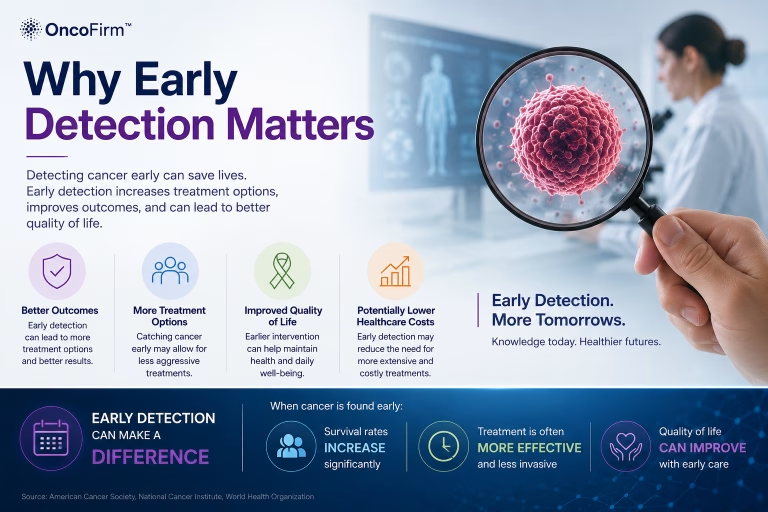
Lead-time and length bias mean that earlier detection and longer survival after diagnosis do not, on their own, show benefit. For that reason the case for early detection has to rest on mortality or on carefully justified surrogate endpoints.
Where AI and point-of-care testing come in
Software and hardware are means, not screening strategies. Machine-learning models bring their own validation requirements, described in AI in cancer diagnostics, and rapid assay formats are mapped in our overview of rapid cancer diagnostic technologies.
OncoFirm™ is developing a research-stage fluorescent lateral flow immunoassay platform for cancer-associated protein biomarkers. Its performance has not been established, and its role, if any, in a screening or triage pathway is a question for future studies.
Open questions research partners could take on
For OncoFirm’s planned grant projects, the screening literature raises practical questions: which intended use is realistic for a protein-biomarker lateral flow assay, which comparator and reference standard a first clinical study should use, and how benign-condition controls should be selected. Biostatisticians, epidemiologists and clinical investigators with access to well-characterized cohorts or biobanks are the natural partners.
The research and development priorities page lists the current questions, and the collaboration opportunities page explains how to propose joint work.
Frequently asked questions
Have multi-cancer blood tests been shown to reduce cancer deaths?
Not in the studies cited here, which report feasibility and the diagnostic workup after a positive result. Trial designs intended to measure clinical utility are discussed by Minasian et al. (2023).
Will blood tests replace mammography or colonoscopy?
The prospective studies cited here were run alongside recommended screening, not instead of it.
Does OncoFirm offer a screening test?
No. OncoFirm’s platform is at the research stage, has no established performance and is not available for clinical use.
Related research and resources
- Why early detection matters — the evidence and its biases.
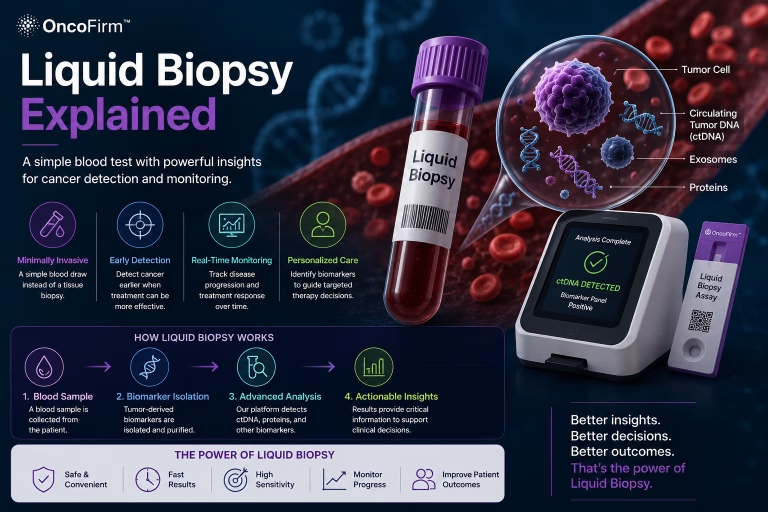
- Liquid biopsy explained — the biology behind blood-based cancer signals.
- Discuss a grant opportunity — raise a study idea.
References and further reading
- Crosby D, Bhatia S, Brindle KM, et al. Early detection of cancer. Science. 2022;375(6586):eaay9040.
- Minasian LM, Pinsky P, Katki HA, et al. Study design considerations for trials to evaluate multicancer early detection assays for clinical utility. J Natl Cancer Inst. 2023;115(3):250–257.
- Klein EA, Richards D, Cohn A, et al. Clinical validation of a targeted methylation-based multi-cancer early detection test using an independent validation set. Ann Oncol. 2021;32(9):1167–1177.
- Lennon AM, Buchanan AH, Kinde I, et al. Feasibility of blood testing combined with PET-CT to screen for cancer and guide intervention. Science. 2020;369(6499):eabb9601.
- Schrag D, Beer TM, McDonnell CH, et al. Blood-based tests for multicancer early detection (PATHFINDER): a prospective cohort study. Lancet. 2023;402(10409):1251–1260.
Research and regulatory status
OncoFirm™ technologies described on this site are in research and development. Their performance characteristics have not been established, and no OncoFirm product has been cleared, approved or authorized by the U.S. Food and Drug Administration. Nothing here is medical advice. Reference to a federal agency or funding program does not imply endorsement, funding, sponsorship or affiliation.